One room, many ideas of knowledge
A library can be recognised by the way it invites us to spend time. One gathers readers between wooden shelves; another draws the eye towards a painted ceiling; a third lets white surfaces and daylight guide the visitor. Architecture gives visible form to an idea of knowledge: a collection to protect, an experience to share, a daily practice.
The Angelica, Trinity College, Admont and the Bibliotheca Alexandrina offer four very different interpretations. Looking closely means following staircases, windows and shelves, while also asking who can enter, how books are cared for, and how the memorable photograph relates to the everyday life of a library.
Rome: the Angelica and the opening of knowledge
A short walk from Piazza Navona, the Biblioteca Angelica was founded in 1604 through the initiative of the Augustinian bishop Angelo Rocca. His collection became the nucleus of an institution intended to welcome readers regardless of their social standing. It belongs among Europe's earliest public libraries; an absolute claim to being the first would flatten a history of different institutions and different kinds of access.
Luigi Vanvitelli's great hall, completed in 1765, places its shelves around the perimeter, turning the books into a continuous landscape. Its beauty lies in the proportions between the height of the woodwork, the tables and the space reserved for readers. The collections also include formerly prohibited texts: preserving them has allowed later generations to study ideas that censorship sought to restrict.
Research continues here. The library distinguishes consultation from a brief visit to the hall, which visitors may view near the entrance without disturbing readers. Notices and scheduled closures should be checked before travelling. Respecting that boundary is part of appreciating the place.
Dublin: reading change at Trinity
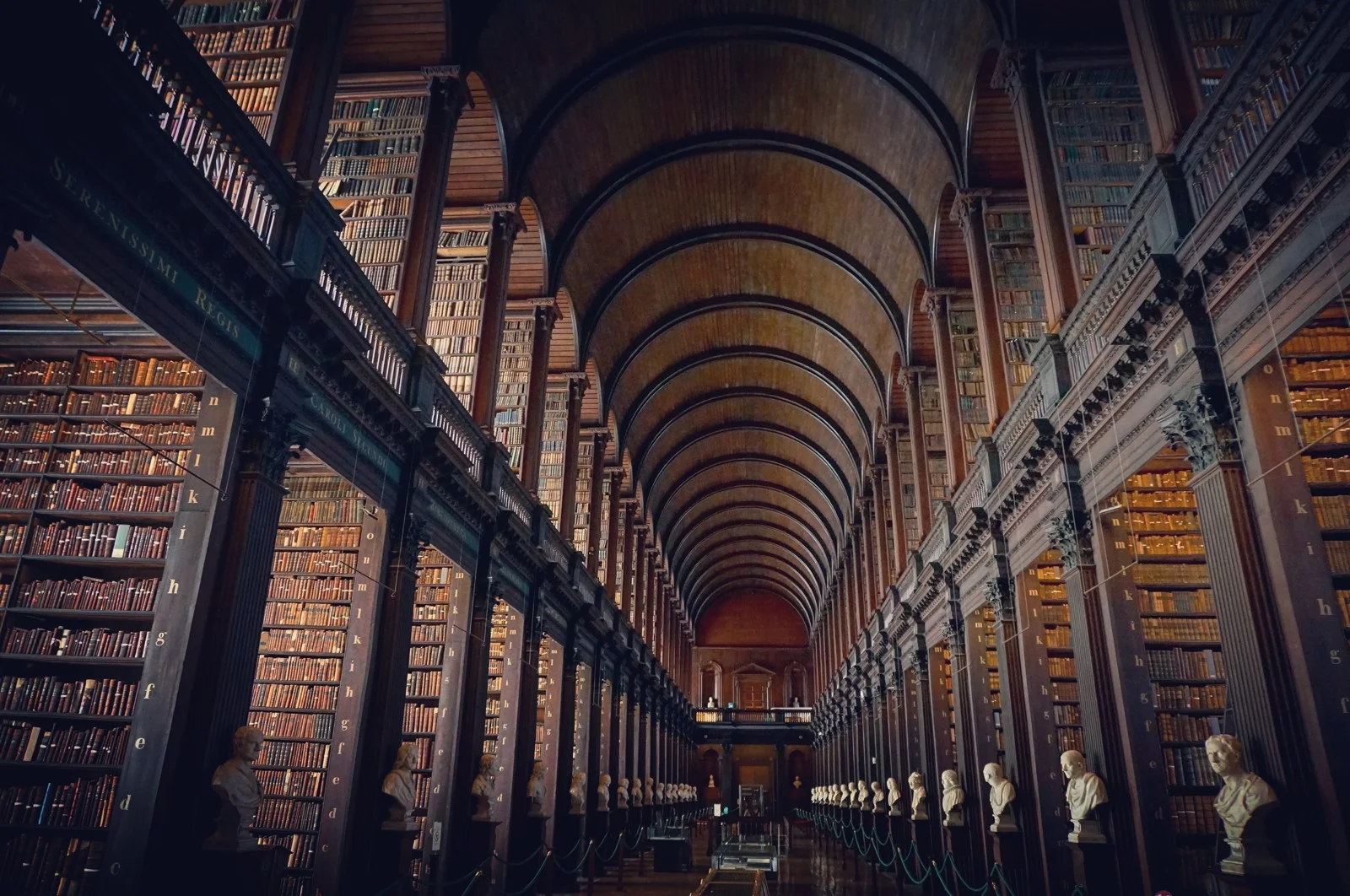
The Long Room in Trinity College's Old Library is instantly recognisable through the rhythm of its arches and the perspective of the great hall. Its best-known images, however, belong to different moments in the building's history. Visitors expecting every shelf to be full should know that the conservation project has involved removing the books, apart from the first four bays at the entrance.
The university's current programme states that the Old Library and Long Room will remain open to visitors until the end of 2027, when restoration and construction works are scheduled to begin. Access to the historic spaces forms part of the ticketed Book of Kells visitor experience; university updates remain the reference when planning a visit.
The largely emptied shelves alter the character of the room. They make its architectural structure more visible and remind us that preservation involves practical intervention. Even an exceptionally famous interior passes through periods of change. Understanding them helps visitors arrive with a clearer picture of what they will see.
Admont: a Baroque vision in daylight
At the Benedictine abbey of Admont in Austria, the library occupies a hall approximately seventy metres long. Completed in 1776 to a design by Josef Hueber, it is described by the abbey as the world's largest monastic library hall. That distinction concerns this particular room, rather than the overall size of a book collection.
White surfaces, gold ornament and windows create a luminous setting. Seven domes and ceiling paintings by Bartolomeo Altomonte form part of a programme exploring knowledge and culminating in divine revelation. The geometric floor and curved shelving keep the eye moving: individual details participate in a larger composition without breaking its continuity.
The year 2026 marks two hundred and fifty years since the hall's completion. Visits follow the abbey's museum route, with a seasonal calendar to check in advance. Allowing time for the collections and exhibitions also helps place the library within an institution that continues to create and present culture.
 Credits: © Jorge Royan / http://www.royan.com.ar · CC BY-SA 3.0 https://creativecommons.org/licenses/by-sa/3.0/ · https://commons.wikimedia.org/wiki/File:Austria_-_Admont_Abbey_Library_-_1256.jpg
Alexandria: an ancient idea in a contemporary form
Beside the Mediterranean, the Bibliotheca Alexandrina reinterprets the idea of Alexandria as a place of learning and exchange through a contemporary project. Inaugurated in 2002, it was designed by Snøhetta with Hamza Associates. Its great tilted disc, reflecting water and public plaza establish a distinctive relationship with the city and the sea.
The reference to the ancient library is cultural: the present building grew from a modern initiative. Inside, reading areas descend across terraces and receive light through north-facing skylights, designed to keep direct sunlight away from the collections. The granite wall, inscribed with characters from different writing systems, brings the meeting of languages onto the exterior.
Libraries, museums, exhibitions and scientific activities form a complex cultural centre. A guided visit can help explain its different functions; the official programme offers tours in Arabic, English and French. Here, too, the most engaging question concerns the present: how can people and knowledge meet, every day, within architecture that has become a symbol?

A visit worth preparing carefully
Before choosing a date, distinguish sightseeing access, research access and a guided visit. Calendars, reservations, building works and photography rules can change. A library also rewards attention to a single detail: a shelf mark, a window, the relationship between a chair and a bookcase. From there, its beauty leads back to a particularly compelling purpose: making an encounter with a book possible.