The fascination of an opening door
A princess leaves a palace, a boat pulls away from shore, a woman disappears beyond the horizon of those who thought they knew her destiny. Such images have nourished myth, novels and cinema. A journey promises another beginning; a disappearance leaves a space that the imagination rushes to fill.
Following Europa, Dido, Adelasia, Anastasia, Elisabeth and Diana, however, means encountering very different departures. They include abduction, a legendary escape, exile, mobility enabled by privilege and the development of a public role. Distinguishing them brings us closer to these figures without turning every separation into a choice of freedom. Even a captivating portrait needs that attention.
Europa: crossing the sea without choosing to leave
In the myth told by Ovid, a Phoenician princess approaches an apparently gentle bull. It is Jupiter, Zeus in the Greek tradition, in another form: when Europa climbs onto its back, the god carries her across the sea to Crete. The image has inspired countless artistic representations. At its heart is an abduction, even when painting gives it a luminous and seductive atmosphere. In the Library attributed to Apollodorus, her brothers, including Cadmus, set out to search for her.
The crossing retains extraordinary visual force: a receding coast, a body suspended over water, the distance between trust and deception. Looking from Europa’s perspective changes the story. Being taken elsewhere is not the same as deciding to leave. The myth can speak about power, desire and transformation, while the woman at its centre invites us to ask how much room she had to choose. Her association with the continent’s name belongs to mythic tradition, and Herodotus already questioned its origin: the story does not establish a historical etymology.
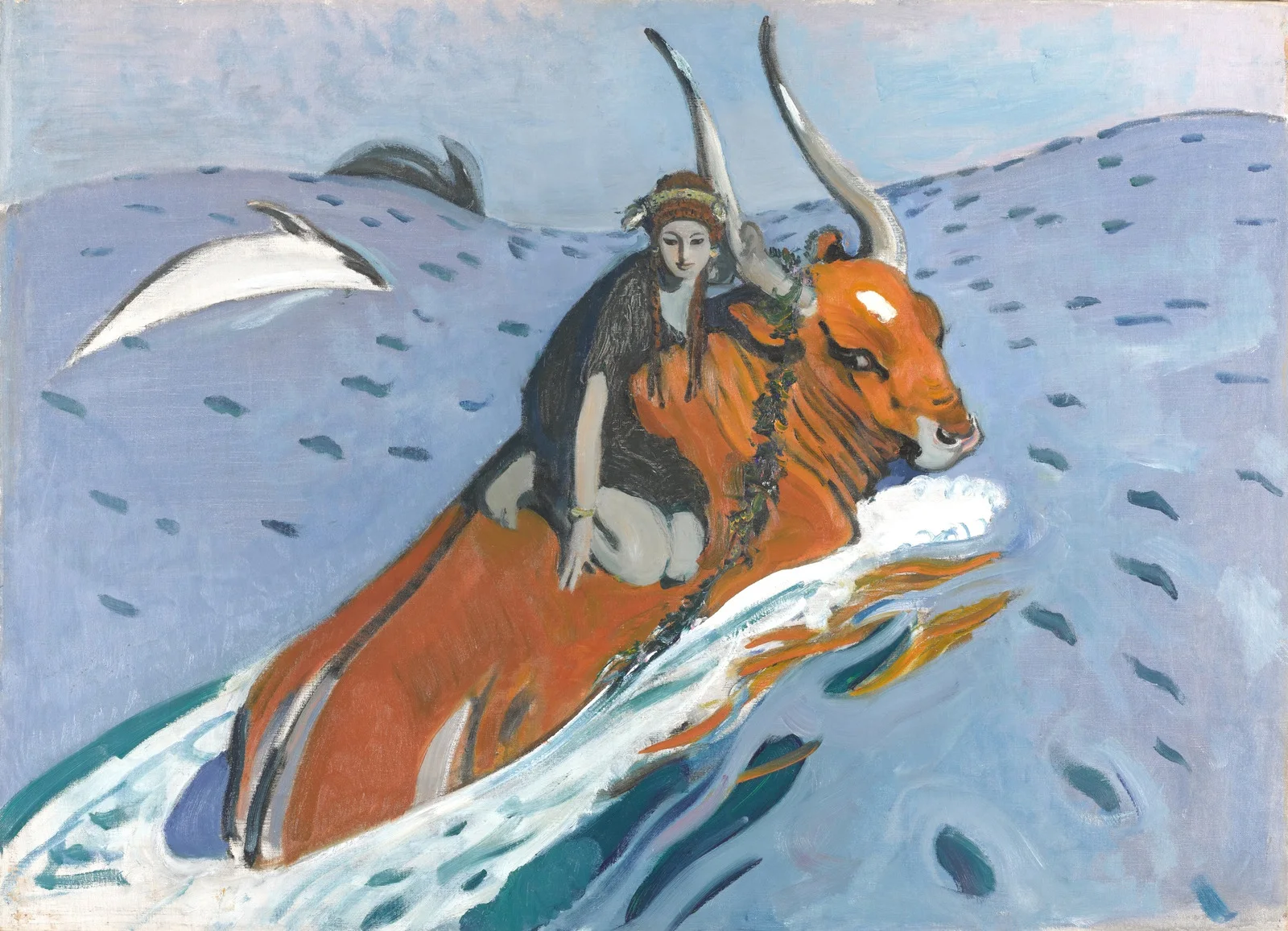 Credits: Valentin Serov, Rape of Europa (1910) / Tretyakov Gallery · Public domain · https://commons.wikimedia.org/wiki/File:Europe_serov.jpg
Dido: a queen before the love story
In the Aeneid, Dido, also known as Elissa, leaves Tyre after her brother Pygmalion kills her husband Sychaeus. She leads a fleeing community and rules the new Carthage. The poem connects the first settlement to land associated with an oxhide; tradition develops the ingenious device of cutting the hide into strips to enclose a larger area. These are foundation stories, to be distinguished from the archaeological reconstruction of the city.
Before her encounter with Aeneas takes centre stage, we see a woman who organises, welcomes and governs. Pausing here restores depth to a queen too easily remembered only through abandonment. Her journey involves collective responsibility: finding land and making a shared life possible. The poem’s tragic development does not erase this capacity for initiative, nor require us to read the character’s whole existence as waiting for a man.
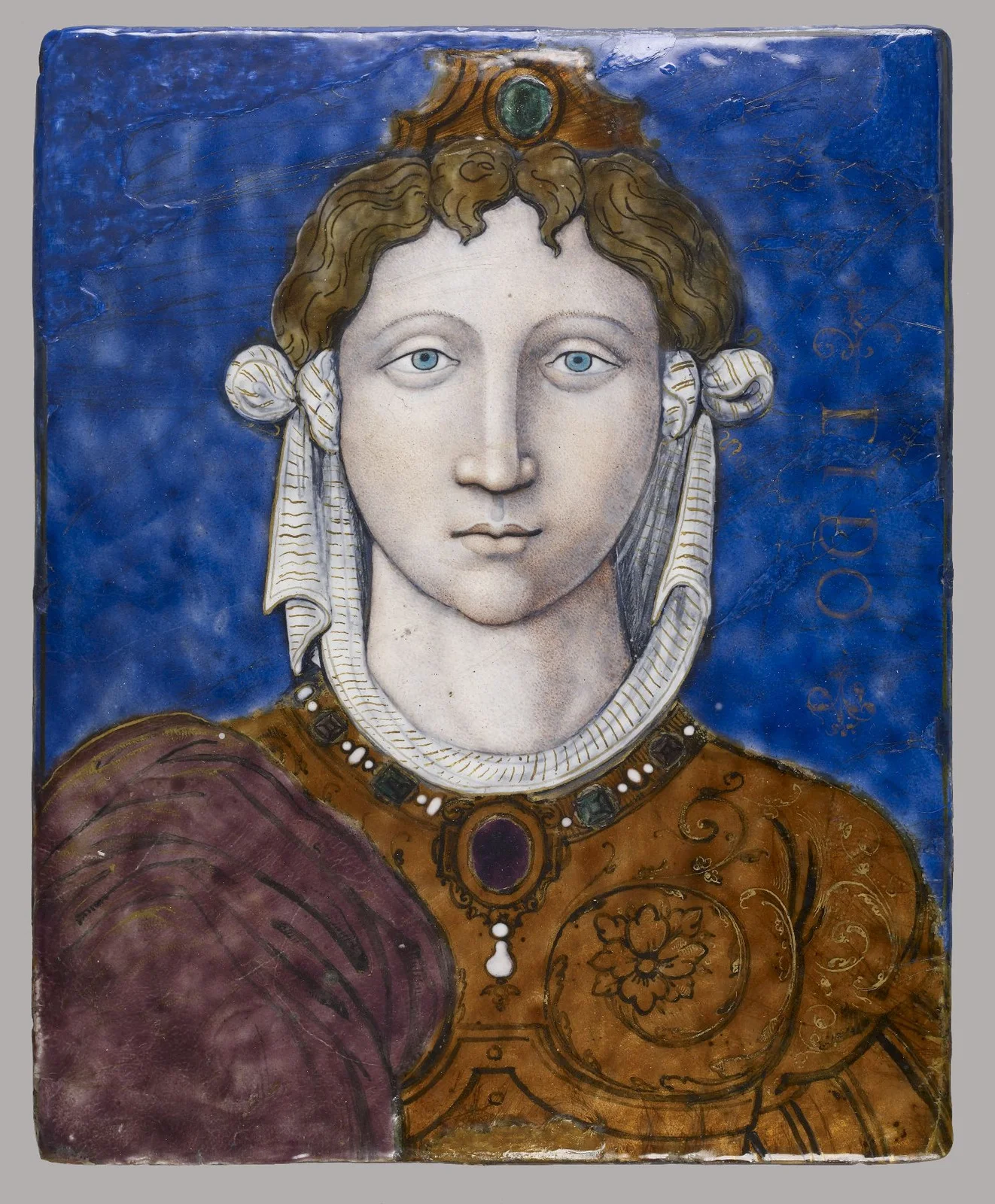 Credits: Léonard Limosin, Dido (c.1564–65) · Photo: Walters Art Museum · CC BY-SA 3.0 https://creativecommons.org/licenses/by-sa/3.0/ · https://commons.wikimedia.org/wiki/File:L%C3%A9onard_Limosin_-_Dido_-_Walters_44240.jpg · resized
Adelasia: an escape for love woven into a landscape
In the hills above Alassio, Adelasia’s name brings together landscape and legend. Local tradition presents her as Emperor Otto I’s daughter, escaping with Aleramo against her father’s wishes. Their refuge is linked to the inland woods and the tower of Vegliasco; the town’s name is traced to hers. This kinship and etymology belong to the legend, without automatically becoming documented genealogy or an account of the town’s foundation.
Part of the fascination lies in the way a community preserves its story: a tower, a path and the outline of the coast become places in which to imagine a courageous decision. The escape for love gives form to a conflict between family authority and individual desire. Walking through these places means encountering a cultural memory, able to give a landscape a voice even when the historical record tells a different story.

Anastasia: when the wish for a happy ending becomes legend
Grand Duchess Anastasia Romanov was killed with her family in Ekaterinburg in July 1918. Remains found in 2007, examined alongside those from the first burial, enabled genetic studies published in 2009 to account for all five Romanov children. The discussion about which sister lay in the second grave, Maria or Anastasia, concerns identifying individual remains, rather than evidence of survival.
The princess who escaped the massacre belongs instead to the legend that travelled through the twentieth century. Such violence can understandably inspire a wish for a secret exit and a rediscovered identity. Novels and films can explore that wish; biography requires us to recognise the young woman who actually lived. Restoring her fate does not diminish the story’s interest: it shifts attention from a promised mystery to the person that mystery threatened to obscure. DNA analysis ruled out Anna Anderson, who claimed to be Anastasia, as a member of the Romanov family.
 Credits: Boissonnas et Eggler, Anastasia (1914) / Galerie Bassenge · Public domain · https://commons.wikimedia.org/wiki/File:Princess_Anastasia_Nikolaevna_1914_portrait.jpg
Elisabeth: the empress beyond the portrait of Sissi
Elisabeth of Austria was an empress, not simply the romantic princess remembered through cinema. ‘Sisi’ was the family spelling of her nickname; ‘Sissi’ spread through the films of the 1950s. Her travels and the Achilleion residence on Corfu reveal a life also lived away from the Viennese court, among personal interests and places chosen for extended stays.
This mobility had the resources and limitations of an exceptionally privileged position. A villa overlooking the Mediterranean does not give us access to every thought of its inhabitant. We can examine routes and objects while allowing the biography its tensions. Elisabeth was assassinated in Geneva in September 1898: violence that interrupted her life, rather than the poetic destination of an escape finally achieved.
 Credits: Franz Xaver Winterhalter, Empress Elisabeth (1865) / Hofburg Palace · Public domain · https://commons.wikimedia.org/wiki/File:Elisabeth_of_Austria,_by_Franz_Xaver_Winterhalter.jpg
Diana: a public presence shaped through actions
After her divorce, finalised on 28 August 1996, Diana retained the name and title Diana, Princess of Wales, without the style Her Royal Highness. Her story extends beyond the image of a woman leaving a palace. She had already developed public work that brought visibility to people and situations often kept at a distance.
In April 1987, at London’s Middlesex Hospital, she shook hands without gloves with a man living with HIV, a public gesture against stigma. In January 1997, in Huambo, Angola, she visited mine-clearance operations: her famous walk followed a cleared lane within a minefield, with protective equipment and specialist assistance. The attention she brought to landmines concerned the danger civilians faced in everyday life.
Reading these episodes means looking beyond a dress or the most frequently reproduced photograph. Her prominence could direct attention towards someone else: a patient, a survivor, a community. Diana died on 31 August 1997 following a car crash in Paris. Her death interrupted that work; recognising what she achieved does not require us to cast it as a final flight into freedom.
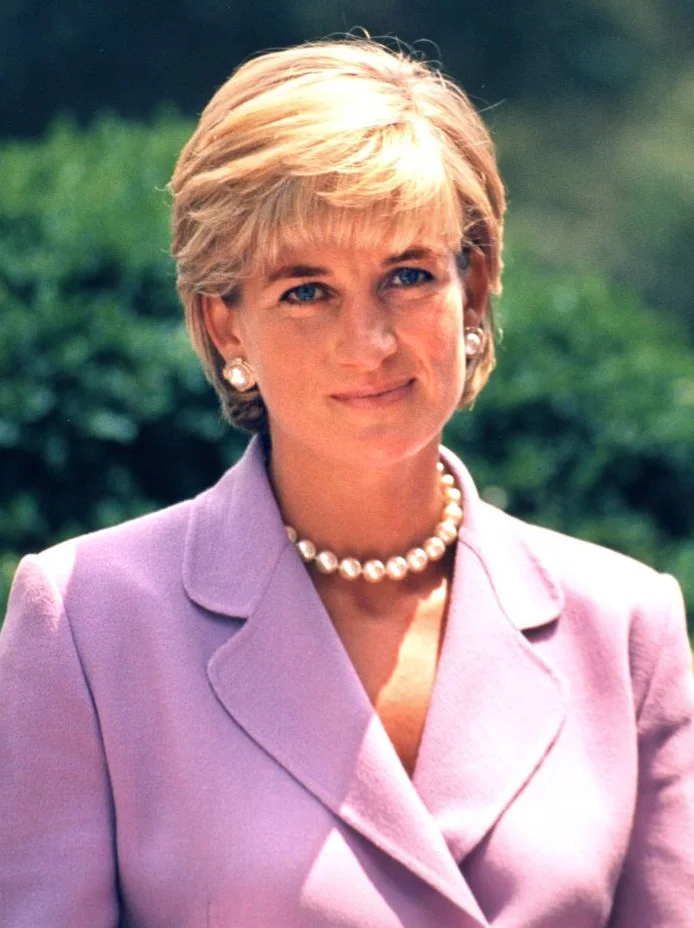 Credits: “BEST ALL-TIME DIANA!” (1997) · © John Mathew Smith 2010 / www.celebrity-photos.com · CC BY-SA 2.0 https://creativecommons.org/licenses/by-sa/2.0/ · https://www.flickr.com/photos/kingkongphoto/5113074392/ · crop/levels adjusted on Commons
Giving each journey its own meaning
These six figures coexist in collective memory, but call for different ways of looking. Myth asks us to consider versions and symbols; legend, the relationship between a community and its story; women who actually lived, their surviving traces, actions and circumstances. Placing them alongside each other can open a conversation, provided their differences remain visible.
The most interesting question concerns freedom in practice: who could choose a destination, with what means and at what cost? A crown can offer opportunities and impose a role. Setting it aside for a moment lets us recognise a literary founder, a murdered young woman, a traveller, a woman engaged in public life. The journey continues in the way we learn to tell their stories.