A row of black buttons, a knotted fringe, an ochre cloth wrapped around the body. In the wardrobes of religions, fabric accompanies prayer, work and public life. Sometimes it makes a vow visible. Sometimes it expresses a personal way of belonging.
Reading these clothes involves distinctions. A celebrant’s vestments, the dress of a monastic community and the everyday choices of worshippers have their own histories and purposes. Within a religion, practices also vary by place, community, gender, occasion and interpretation. This journey begins with Latin Catholic dress and continues through Islam, Judaism, Buddhism, Sikhism, Hinduism and Jainism.
Catholic Christianity and the origins of clerical dress
Liturgical garments did not all begin as uniforms separate from society. In Christianity’s early centuries, celebrants wore clothing of the Roman world. Some forms gradually remained in worship as civilian dress changed: the tunic developed into the alb, while the enveloping cloak called the paenula became the chasuble, the priest’s outer vestment at Mass.
This gives their silhouettes a particular interest: something ordinary can acquire solemnity through survival. A broad chasuble makes drape visible; shorter, stiffer versions place more emphasis on the decorated surface. These are different ways of accompanying a gesture, as well as different quantities of cloth.
The colour of a role and the colour of worship
A priest’s black cassock and a coloured chasuble belong to different codes. In ecclesiastical clothing, clerical black, episcopal violet, cardinal scarlet and papal white can indicate office. A liturgical vestment’s colour follows the celebration: wearing red does not change a priest’s rank.
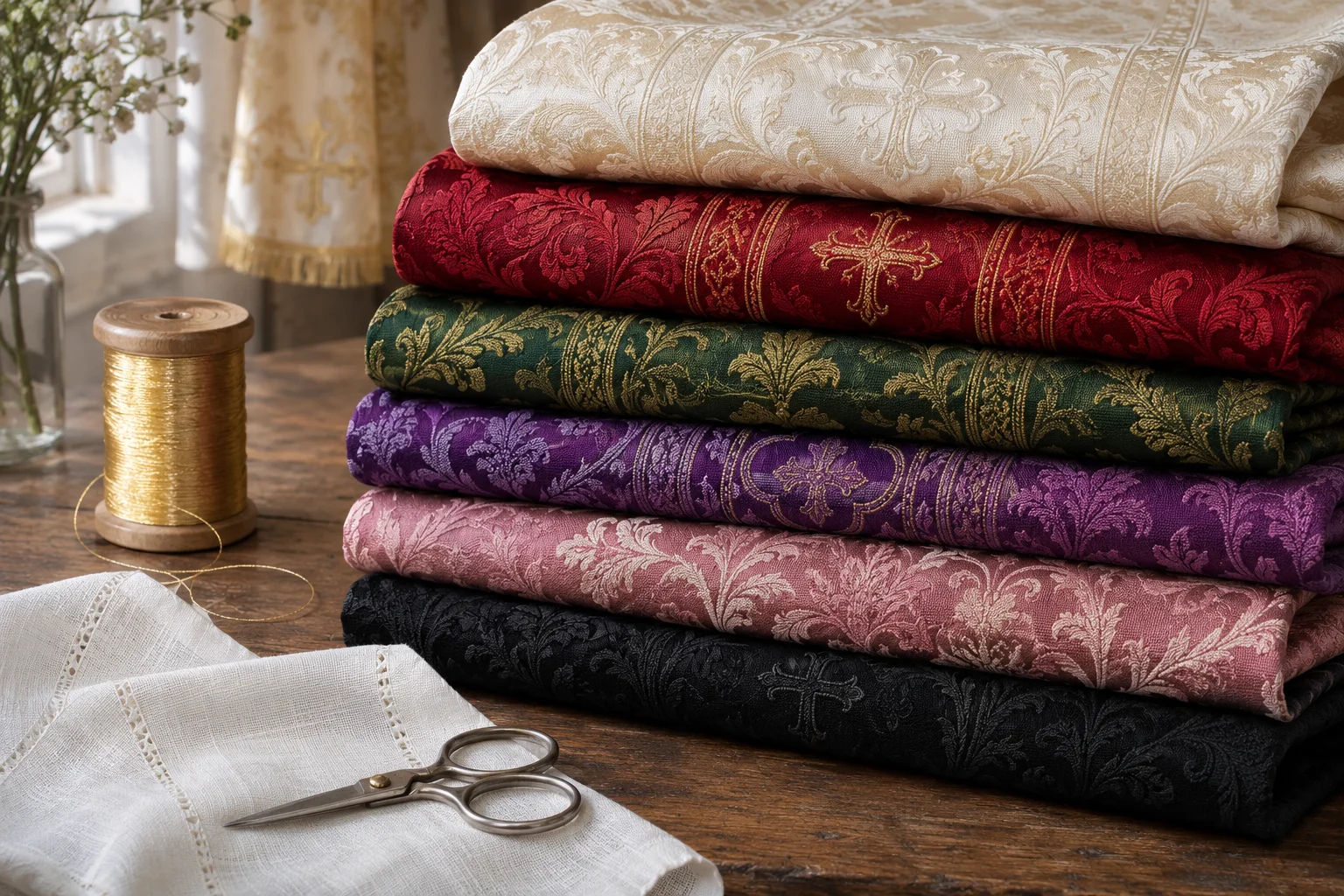
Colours and textures of Roman-rite vestments. Illustrative composition.
In the Roman rite, briefly: white at Christmas and Easter; red for Pentecost, the Passion and martyrs; green in Ordinary Time; violet in Advent and Lent, also permitted for the dead. Black for the dead where customary; rose optionally, according to tradition, on Gaudete and Laetare Sundays. Legitimate local adaptations exist.
Fabric also has a job to do
Embroidery is visible; a well-chosen lining often is not. Yet weight, breathability and drape matter as much as decoration, especially in clothing worn for long periods. Wool, cotton, linen and silk belong to ecclesiastical tailoring’s repertoire: not every garment is precious brocade, and communities do not all dress alike.
The Missal’s norms also allow other suitable fibres and place beauty in form and material before lavish decoration. There is a design lesson here: cloth must serve a purpose as well as make an image.
Sisters do not share one universal habit
Speaking of “a nun’s outfit” conceals many differences. Tunic, veil, scapular and wimple can be combined in different ways; colours and shapes depend on the community. They do not automatically change with the calendar of the Mass. A recognisable silhouette alone cannot reliably identify a congregation.
In 1965, the conciliar decree Perfectae caritatis called for simple, modest habits suited to health, time, place and ministry. It did not order the universal disappearance of the veil: it set criteria for revising clothing that no longer met those needs.
A particularly visible change had already affected the Daughters of Charity on 20 September 1964: they abandoned the large cornette, the white headdress with starched “wings”. Their community’s history recalls that this apparently timeless shape had itself developed through earlier changes. Tradition contains more movement than a photograph might suggest.
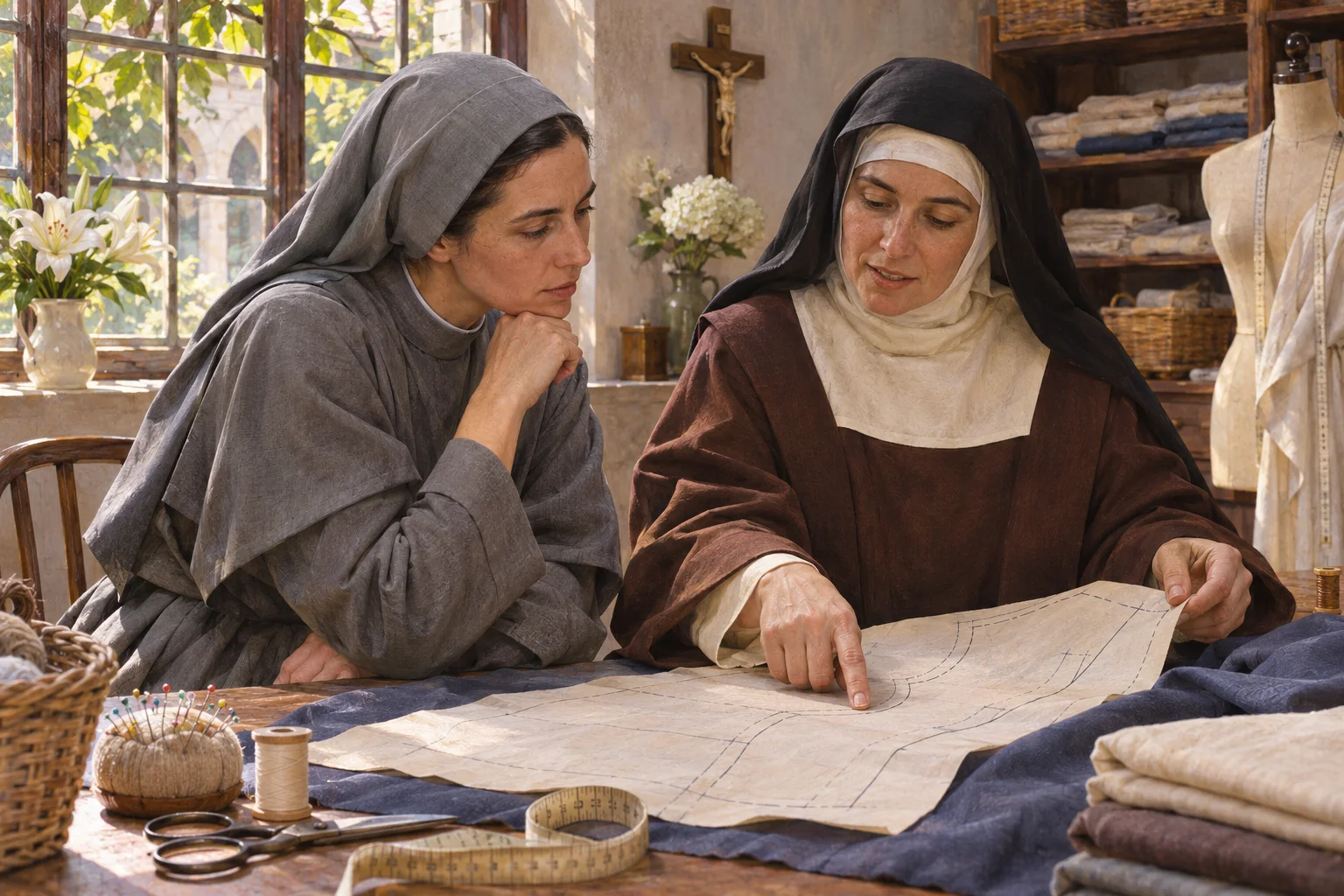
Different religious habits for daily life. Editorial illustration, not depicting a specific congregation.
From tailoring houses to artists
In Rome, Gammarelli traces its business to 1798. Ecclesiastical tailoring works with measurements, purposes and customs: a different task from creating a collection inspired by religion. Its shared ground with couture is attention to cut; the client and final use change the brief.
Henri Matisse approached the subject for the Chapel of the Rosary in Vence. Between 1950 and 1952, he worked on chasuble designs, bringing the language of his paper cut-outs to vestments. This was an artist considering colour, space and liturgical purpose, rather than simply adding a cross to a dress.
For Notre-Dame de Paris’s reopening in December 2024, Jean-Charles de Castelbajac designed vestments with a golden cross and fragments of colour against a pale ground. The project uses ivory-white wool gabardine: a reminder that modernity can reside in material as well as graphic expression.
When sacred imagery enters fashion
The Metropolitan Museum’s 2018 exhibition Heavenly Bodies explored the dialogue between Catholic imagination and fashion. This is a different relationship from clothing made for worship: a runway reference can quote religious dress without taking on its purpose or meaning.
Islam and the design of modest fashion
For many Muslim women, the relationship between faith and clothing is worked out in everyday life. A headscarf worn as hijab can accompany layered clothes, trousers and jackets, with different choices of coverage and volume. Research presented by the Open University describes young women in Europe reworking the clothes their peers wear in this way. Family, place, personal conviction and fashion culture all play a part. Veiling has many forms and histories.
The exhibition Contemporary Muslim Fashions brought this range of approaches into museums. Indonesian designer Dian Pelangi is represented by clothing made with batik, organza and silk brocades woven with metallic thread. Surfaces can be vivid, intricate and luxurious while the cut provides the coverage a wearer wants. Alongside Matisse’s work for a chapel, her designs suggest another relationship between creativity, faith and the person for whom clothes are made.

Designing cuts and textiles for everyday dress. An illustrative atelier scene with a fictional figure.
Judaism and the meaning of a fringe
The defining detail of the tallit, the Jewish prayer shawl, sits at its corners. Tzitzit, fringes knotted at the four corners, recall the commandments. London Museum holds a shawl once owned by Rabbi Avraham Werner, made with wool, silk and cotton. White cloth with black stripes is a familiar combination, while the Jewish Museum of Greece also documents silk shawls with pale blue or violet-blue stripes.
The kippah, a small head covering, also leaves room for craftsmanship in its fabrics and decoration. It is worn by many worshippers, with customs varying among communities. Understanding a Jewish wardrobe means considering ritual use, local tradition and individual choices together. The clothes of a single rabbi offer one part of a much larger picture.
Buddhism and the geometry of a robe
Saffron is one of many images associated with Buddhist dress. In Thailand, monks’ robes can range from orange to different shades of brown, depending on the community. Ways of rolling the edges and arranging the cloth can vary too. Where winters are harsh, extra layers answer a very practical need for warmth.
In Japan, the kesa offers another lesson in construction. This rectangular outer vestment is assembled from sewn panels. The Smithsonian’s National Museum of Asian Art holds Edo-period examples made from silk brocade. The eye can follow both the grid of seams and the fabric’s pattern. A monastic tradition can preserve extraordinary evidence of textile skill.

Panels and seams in a garment inspired by a Japanese kesa.
Sikhism and the turban as a visible commitment
The dastar, the Sikh turban, can be worn by men and women. Wrapping the cloth around the hair creates a recognisable public presence. The Sikh Coalition describes it as a commitment to service, compassion and honesty. The five articles of faith of initiated Sikhs include kesh, unshorn hair, and the steel bracelet called kara. Even a simple material can hold a meaning that accompanies its wearer throughout the day.
Hinduism and the colours of monastic life
Ochre appears in several Hindu traditions of renunciation. A specific example comes from the Ramakrishna Math, which describes a wardrobe of kurta, dhoti and a cloth over the shoulders. In this order, white identifies novices or brahmacharins and ochre, known as gerua, identifies sannyasins. The colour makes a stage of religious life visible. Other Hindu traditions have their own practices, best understood in their particular setting.
Jainism and renunciation through dress
Among Śvetāmbara Jain ascetics, men and women wear white. In the Digambara tradition, fully initiated monks take renunciation of possessions as far as wearing no clothing. Digambara nuns wear white garments. This difference makes particularly clear how dress can express a spiritual discipline, extending to the decision to relinquish cloth itself.
The people who shape continuity
In these wardrobes, change passes through many hands. Tailors adapt garments, communities reconsider their use and designers imagine new cuts. A person deciding how to wrap a cloth or combine a headscarf with other clothes also contributes to that history. Appreciating the colours and workmanship means making room for their wearer, the rituals they accompany and the meanings they carry in everyday life.