A bikini takes up little room in a suitcase and a great deal in the imagination. A triangle of fabric can evoke holidays, desire, modesty and control over the body. Brazil is one of the countries that has most strongly made it a cultural symbol: in Rio especially, the beach became a place where swimwear is watched, adapted and interpreted.
Calling Brazil the country “proudest” of the bikini would imply an impossible ranking. Yet it is difficult to tell the two-piece’s story without Ipanema and its ability to turn clothing into a way of occupying public space.
1946: a French beginning
Two-piece swimsuits already existed in the 1930s. The modern bikini dramatically reduced their proportions. Jacques Heim and Louis Réard were central to its launch in 1946; Réard’s presentation at Paris’s Piscine Molitor on 5 July became the defining date. Its name referred to Bikini Atoll, the site of nuclear tests: a publicity choice rooted in its period, with a real and painful history behind it.
A Réard example held by the Palais Galliera, dated between 1946 and 1950, reminds us that this revolution also had a material existence: fibres, seams and small metal components. Provocation became an object to construct, fit and sell.
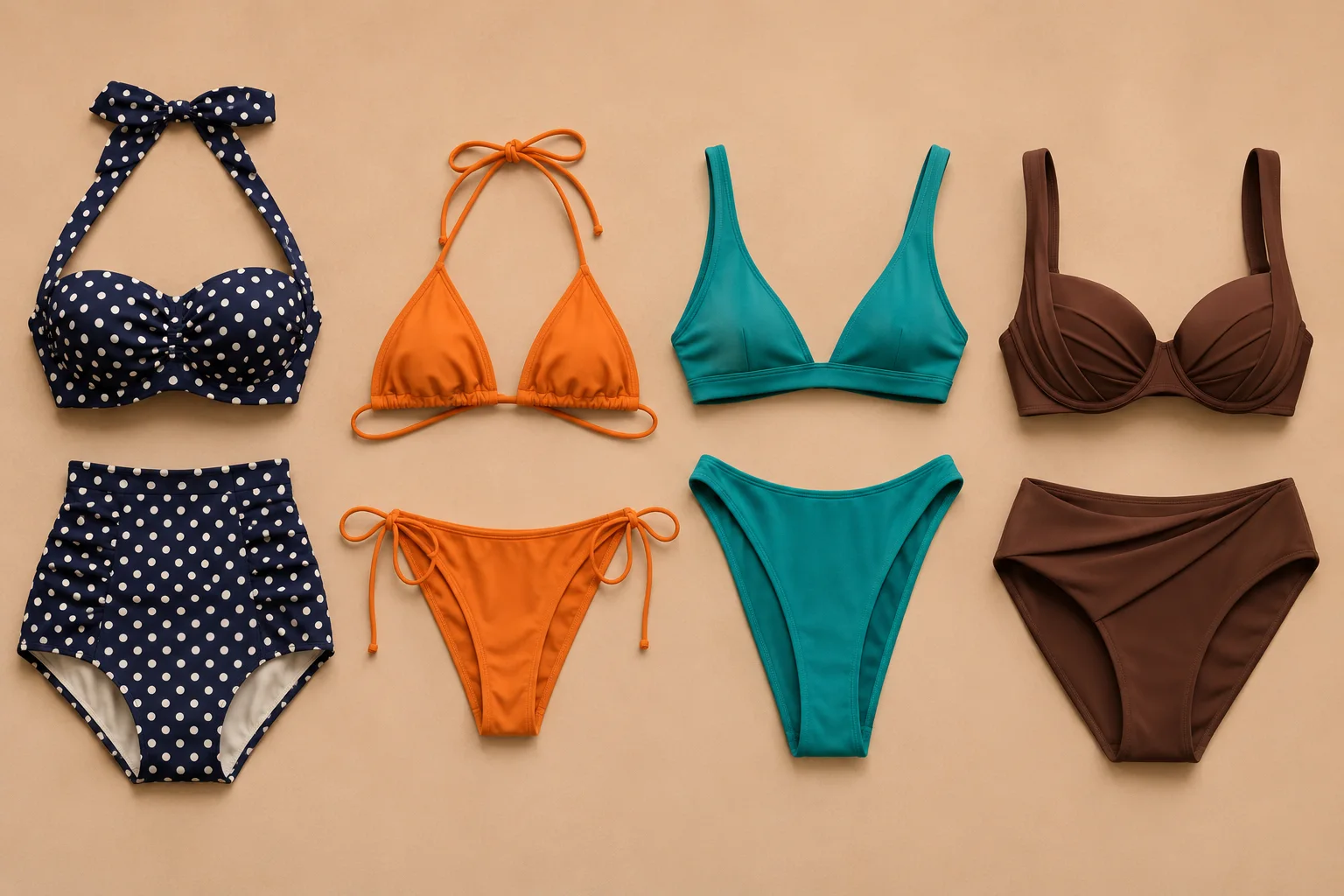
Four interpretations of two-piece silhouettes. Illustrative composition, not a display of historical objects.
Silhouettes do not move in a straight line
During the 1950s, swimwear echoed the defined waists and constructed shapes of the post-war wardrobe. Towards the end of the twentieth century, high-cut legs, strapless bandeau tops and matching sarongs widened the repertoire. From 1989, the red one-piece swimsuits of Baywatch also entered the collective imagination: the bikini develops alongside other styles rather than erasing them.
From stardom to everyday beach life
Brigitte Bardot helped popularise the bikini on the French Riviera. During the 1960s, cinema and celebrity imagery accompanied a new visibility of the body; in 1964 Rudi Gernreich pushed the debate beyond the two-piece with his monokini. It was not a conventional bikini, but a design questioning the rules of covering and revealing.
An image’s success does not describe every woman’s experience. A swimsuit can seem liberating on a magazine cover while still attracting judgement on a beach. Between freedom as an idea and freedom in practice remain families, social expectations, money and other people’s scrutiny.
In Brazil, the body enters public debate
In 1971, Leila Diniz showed her pregnant belly in a bikini on Ipanema beach. Brazil’s National Archives recalls the controversy this caused in the social climate of the time. The image changed the subject: the maternal body did not necessarily have to be hidden or removed from beach life.
This was about more than a swimsuit’s hemline. It does not mean all Brazilian women were already free from restrictions. It makes a dispute visible: who decides which bodies may appear, at what stage of life and in what clothing? The Brazil associated with bikinis is neither a single woman nor a compulsory silhouette.
Tanga and fio-dental: reduction becomes a language
Rio’s contribution includes the popularity of increasingly reduced bottoms, from the tanga to the fio-dental. Retail names can overlap: a tanga generally exposes more of the buttocks than a conventional brief while retaining a triangular rear panel; a fio-dental, literally “dental floss”, reduces this to a very narrow strip. A high-cut leg describes how far the garment rises at the hip, which is a separate variable.
There is no need to invent one designer or an undisputed date for every disappearing centimetre. Shapes circulate between beaches, workshops, brands and images. Brazil’s reputation also lies in this continuing exchange between people who design swimwear and people who wear it.

Tanga and fio-dental, front and back: illustrative interpretations of different coverage. Brand terminology varies.
Fabrics change movement
The story is not simply one of using less cloth. Stretch fibres changed fit and shape recovery: the elastane marketed under the LYCRA name was invented in 1958 and found applications in swimming and beachwear. A swimsuit could follow the body differently.
In a swimwear collection, lining, support, seams and secure ties deserve as much attention as colour. A triangle top and a structured cup top have different constructions; a cut photographed motionless must also be imagined walking or entering the water.

High waist, triangle and bandeau: three ways to wear a two-piece.
The designers who shaped moda praia
Jacqueline and Tunico De Biase founded Salinas in 1982; its first Ipanema boutique opened in 1988. Lenny Niemeyer, after designing for other labels from 1979, established her own brand in 1991, also in Ipanema. These careers show Brazilian beachwear developing a design culture beyond the image of the beach itself.
Within that world, swimwear can converse with the wider wardrobe: a pareo changes the silhouette, a light shirt accompanies the move from sand to terrace, and accessories alter the mood. A woman dressed for the beach is more than the number of centimetres she leaves uncovered.

A triangle bikini and matching pareo
The most interesting direction is choice
Tropical patterns, crochet details and cover-ups coexist in contemporary beachwear: FARM Rio’s swimwear selection provides a verifiable example. One collection cannot establish how the whole world dresses, but it does show how a bikini can belong within a complete look.
One way to read its evolution is through the freedom to choose: a high or low waist, tanga or fuller brief, support or simplicity, one-piece or bikini. No cut proves emancipation by itself. A more tangible advance is being able to wear it without having to justify age, motherhood, size or the wish to cover up.
Eighty years after 1946, the bikini keeps changing because the conversation around the body changes. The question it leaves on the sand is how much room there is for the woman making the choice.