


A small terracotta vessel, a red surface, colour transferring to fingertips. Aker fassi belongs to an idea of beauty in which container, pigment and gesture seem inseparable. Long before twist-up lipstick and pressed blush, sophisticated ways of colouring the face already existed.
This is not the story of a world that “had no make-up”. Women, and in various societies men too, had different tools: mineral powders, plant materials, oils, fats and small applicators. The desire to transform appearance long predates the cosmetics industry.
What is aker fassi?
The name, commonly written عكر فاسي and also transcribed as akar or akkar fassi, refers to Fez in Morocco. It is a traditional pigment for lips and cheeks. Moroccan manufacturers describe dried, ground red poppy petals, Papaver rhoeas, often combined with pomegranate peel: preparations are not all identical.
It can appear as powder or as colour coating a small terracotta support. Traditionally, the surface is dampened to collect the pigment. The effect belongs to the language of adjustable colour rather than a uniform mask.
Presenting it as one fixed, unchanging recipe would erase the variety of preparations. Its chronology also requires care: the association with Fez is recognisable, but it does not establish a precise invention date or a single creator.
Fez is not a shortcut to the pharaohs
Aker fassi and ancient Egyptian cosmetics belong to different historical contexts. There is no documented genealogy here connecting this particular Moroccan pigment to a pharaonic recipe. A similar gesture — colouring lips or cheeks — does not prove continuity of a formula.
The comparison becomes more interesting when the differences remain visible. In both cases, faces are shaped using available materials and transmitted knowledge; ingredients, objects, meanings and routes of exchange differ. The past is not one enormous “Oriental” beauty case.
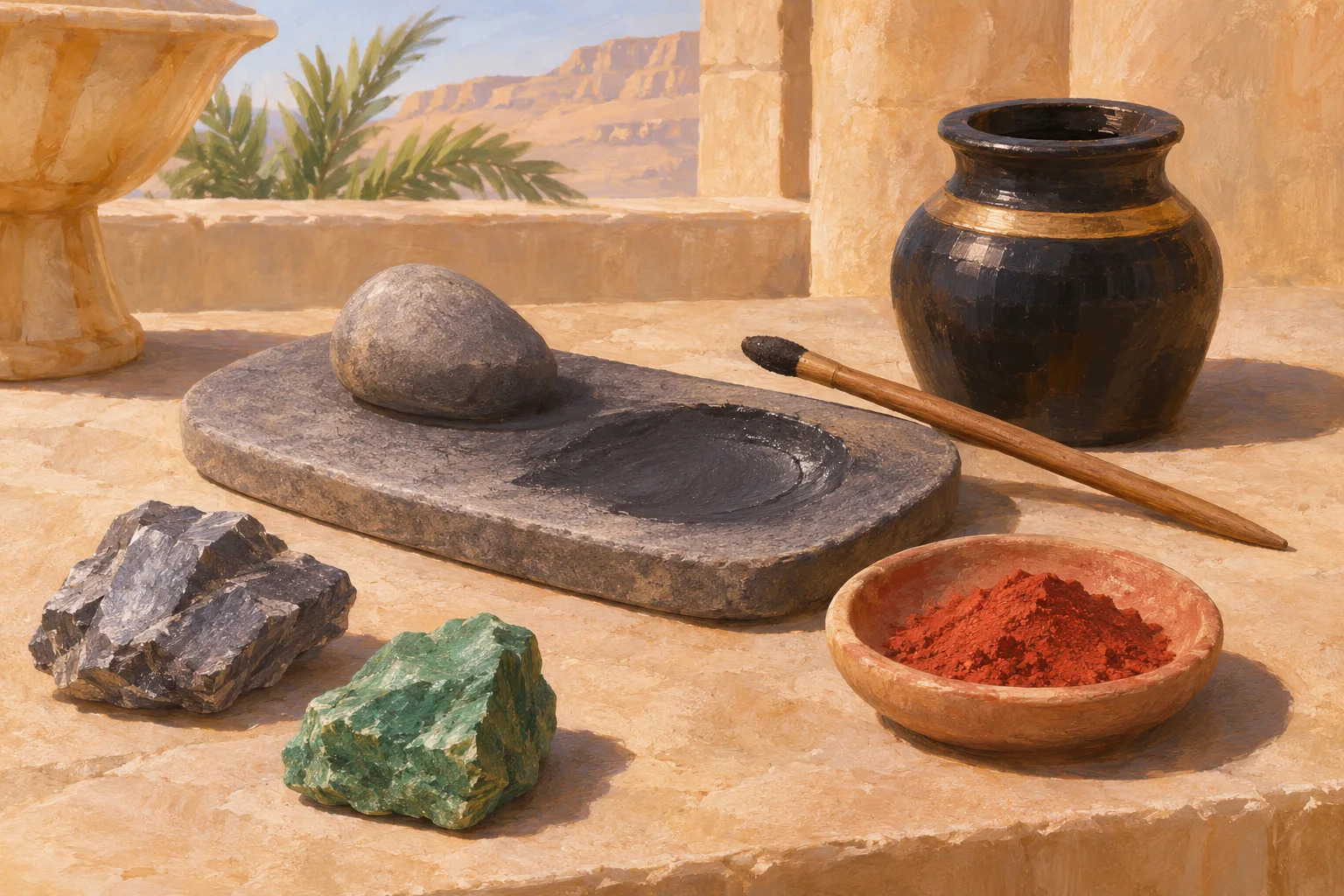
Palette, vessels and pigments: an illustrative reconstruction inspired by Egyptian cosmetic equipment, not a photograph of artefacts.
Ancient Egypt had a real cosmetic toolkit
Burial finds attest to cosmetics as early as the Predynastic Period. Mirrors, combs, perfume vessels and eye-paint containers describe an organised activity rather than an occasional improvisation. Men and women could wear cosmetics; their equipment brought together adornment, bodily care and protective beliefs.
Malachite supplied green material for eye paint; galena, a lead-bearing mineral, supplied grey-black. Earth pigments such as red ochre could colour lips and cheeks. Powders, palettes and applicator sticks belong to this story as much as the dark outline we recognise in Egyptian portraits.
Associating everything with Cleopatra compresses millennia of practice into one person. Nor can an image of a dark-lined eye reveal the exact formula: a pigment’s appearance is not a material analysis.
Charcoal, soot and kohl are not synonyms
Black colour did not come from a single ingredient. Historical accounts of kohl describe preparations containing minerals and, in other cases, carbon-based materials such as soot. Calling all of it “ground charcoal” is inaccurate: similar names cover different compositions across places and periods.
Soot is the fine deposit produced by incomplete combustion; it is not interchangeable with any piece of charcoal. This distinction helps reveal the preparer’s work: obtaining a powder, making it fine enough, choosing a way to spread it and storing it were practical tasks.
Red, green and black: an already complex palette
Egyptian museum documentation also describes mixtures in which fats or oils made coloured earths workable. Ancient make-up was not necessarily a plant rubbed on a face: it involved processing, tools and containers. Craftsmanship preceded industrial packaging.
Aker fassi opens another route within this larger story: plant pigments in Moroccan tradition. It should not be confused with henna, made from leaves and used for more lasting staining. Colour intended for lips and cheeks is not automatically a hair dye or an eye product.

Red on lips and cheeks in everyday beauty. Editorial illustration, not a product test.
What tradition cannot guarantee
The appeal of an old or handmade object does not establish the safety of every formulation sold today. The FDA warns that some traditional cosmetics sold as kohl, kajal or surma can contain high levels of lead. Describing galena in an archaeological object is not a recommendation to apply it.
For a contemporary product, declared composition, traceability and intended use matter. This is not a guide to making eye cosmetics with minerals, ash or charcoal; “natural” alone does not establish safety. Aker fassi should be understood as a cosmetic, without therapeutic promises or an assumption that it must be superior to modern formulations.
The gesture that remains
Today, the aker fassi name also appears in balms and other reformulated products. A link to tradition can survive changes in texture, ingredients and packaging: products sharing the same cultural reference need not have the same formula.
Its narrative strength lies in a red colour that makes us look at make-up before automation. Behind coloured lips were harvesting, grinding, trade, skill and choice. Modern cosmetics changed how colour is purchased and applied; they did not invent the desire to use it for self-expression.


