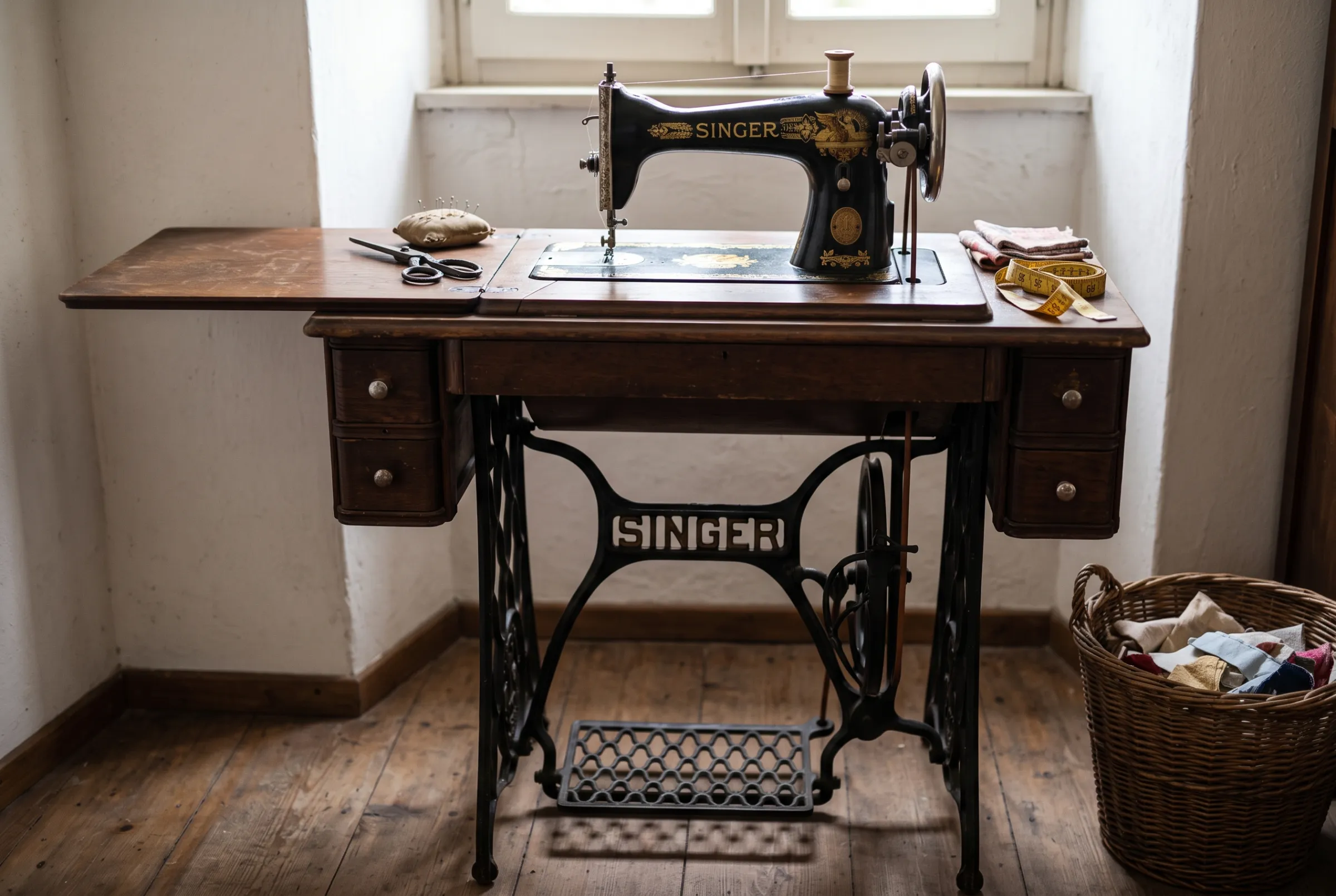
One Stitch at a Time: The SINGER Revolution
The history of the sewing machine doesn't strictly start with Isaac Merritt Singer, but he is the one who made it an immortal icon. In 1851, Singer patented the definitive, practical version of this invention, introducing the suspended arm, the vertically moving needle, and above all, the continuous feed mechanism for the fabric. It was the dawn of an empire that would transform society.
The Treadle Revolution and the Value of Time Singer's true stroke of genius was the introduction of the foot treadle. Before this, machines were hand-cranked, forcing the user to guide the fabric with only one hand. The treadle freed both hands, exponentially increasing speed and precision. This was not just a technical improvement, but a revolution of time: before the sewing machine, making a man's shirt required about 14 hours of hand sewing; with the treadle SINGER, the time plummeted to about an hour and a half. This drastic time-saving freed women from hours of grueling labor, granting them, for the first time, free time to dedicate to education, reading, or their children.
Economic Independence and the Invention of Installments The treadle SINGER soon became the beating heart of millions of homes and created a new class of self-employed female workers. Women could now take in commissioned sewing work and work from home, earning their own income to support their families without suffering the harsh conditions of early industrial factories.
There was, however, an obstacle: the initial cost was prohibitive for an average family. To overcome this, SINGER introduced one of the most important commercial innovations in history: the installment plan (hire-purchase). This system not only made the machine accessible to the masses but also gave women the opportunity to manage a long-term household budget. The machine essentially "paid for itself" through savings on clothing or earnings from tailoring work, effectively democratizing fashion and allowing all social classes to wear dignified, well-made clothes.
From Mechanical to Digital SINGER's strength has been its ability to evolve without ever losing its identity. In the 1920s, the company introduced the first electric motors. In 1933 came the legendary Featherweight, a portable aluminum model that became every seamstress's dream. The 1970s saw the introduction of the first electronic machines, leading up to the present day.
Contemporary SINGERs are essentially computers: touch screens, automatic needle threaders, and digital embroidery modules downloadable via Wi-Fi. Yet, despite the high technology, the rhythmic sound of the needle and the ancient allure of creating something with one's own hands remain unchanged, connecting the past to the future with an invisible but unbreakable thread.